 |
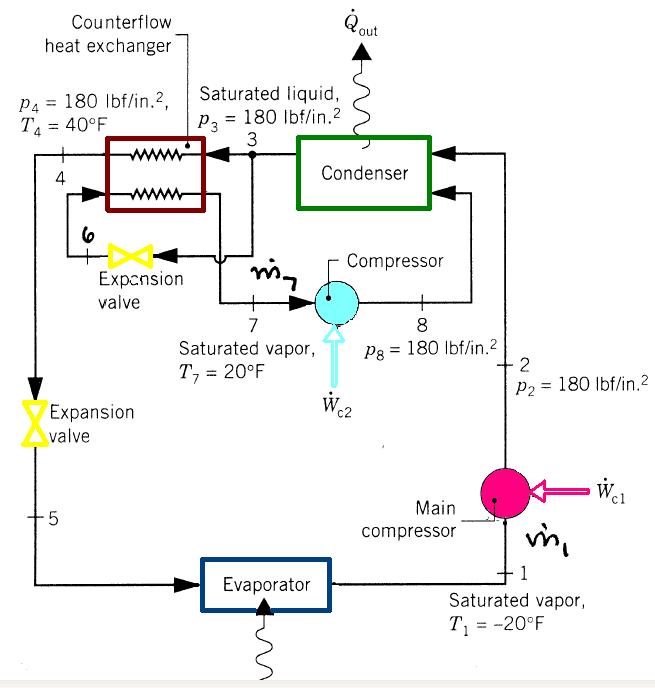
The figure shows a Refrigerant-22 vapor-compression refrigeration
system with mechanical subcooling. A counterflow heat exchanger
subcools a portion of the refrigerant leaving the condenser below the
ambient temperature as follows: Saturated liquid exits the condenser at
180 psi. A portion of the flow exiting the condenser is diverted
through an expansion valve and passes through the counterflow heat
exchanger with no pressure drop, leaving as saturated vapor at 20
°F. The diverted flow is then compressed isentropically to 180 psi
and reenters the condenser. The remainder of the flow exiting the
condenser passes through the other side of the heat exchanger and exits
at 40 °F, 180 psi. The evaporator has a capacity of Qin tons and produces – 20 °F
saturated vapor at its exit. In the main compressor, the refrigerant is
compressed isentropically to 180 psi.
Problem from Fundamentals of Engineering
Thermodynamics, 5th Ed. by Michael J. Moran and Howard N.
Shapiro. John Wiley & Sons, Inc. 2004.
8 Steps to
Engineering Problem Solving: 1. Abstract Problem 2.
List Variables 3. State Basis of Calculations 4. Make/State
Assumptions 5. List References 6. Develop Model
Equations 7. Solve Equations 8. Interpret Solutions, Make
Conclusions |
 Start
here. Read the following, then click "Get Values."
Start
here. Read the following, then click "Get Values."